ELECFREAKS Analog Photocell Brick
Description
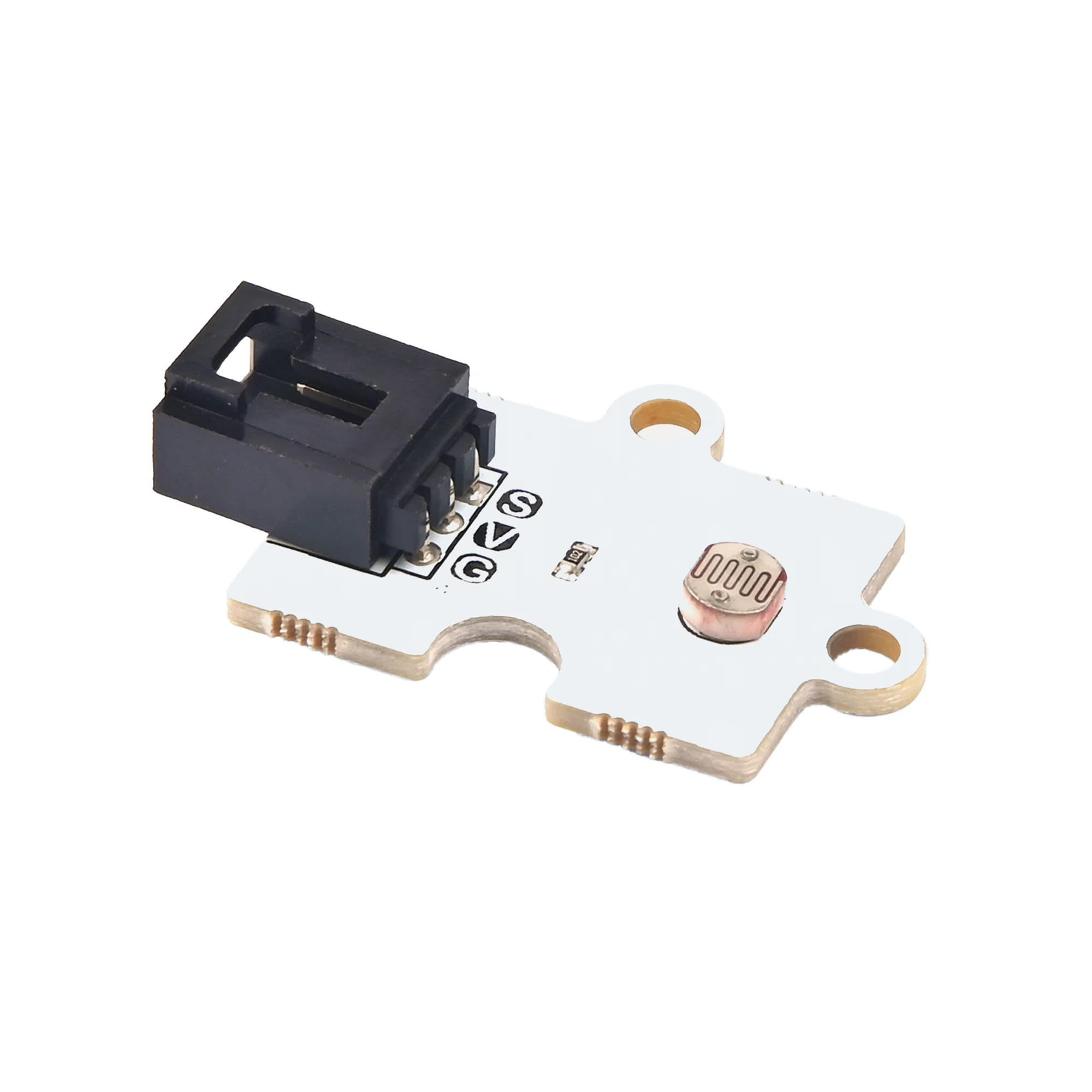
Photocells are sensors that allow you to detect light. They are small, inexpensive, low-power, easy to use and don’t wear out. For that reason, they often appear in toys, gadgets, and appliances. They are often referred to as CdS cells (they are made of Cadmium-Sulfide), light-dependent resistors (LDR), and photoresistors.
Photocells are basically a resistor that changes their resistive value (in ohms Ω) depending on how much light is shining onto the squiggly face. They are very low cost, easy to get in many sizes and specifications, but are very inaccurate. Each photocell sensor will act a little differently than the other, even if they are from the same batch. The variations can be really large, 50% or higher! For this reason, they shouldn’t be used to try to determine precise light levels in lux or millicandela. Instead, you can expect to only be able to determine basic light changes.
For most light-sensitive applications like “is it light or dark out”, “is there something in front of the sensor (that would block light)”, “is there something interrupting a laser beam” (break-beam sensors), or “which of multiple sensors has the most light hitting it”, photocells can be a good choice!
The Freaduino Sensor Shield is the perfect shield to connect this sensor to Arduino. Or Freaduino UNO which we had a pre-stray Octopus Brick interface.
Packing List
| Analog Sensor Cable | 1 pc |
| Octopus Analog Photocell Brick | 1 pc |
Specifications
| Power Supply | 3.3V~5V |
| Connector Type | Analog |
| Pins Definition | 1-Signal 2-VCC 3-GND |
| Response | Quick response with high sensitivity |
| Circuit | Simple |
| Stability | Stable and durable |
Related products
$3.90
$6.60
$3.90